How to Set Up a STAR Grid Bot
STAR Grid Bot automates trading by placing buy and sell orders at predefined price levels. It profits from market volatility without requiring constant monitoring.
This guide covers all STAR Grid parameters, recommended strategies for different market conditions, and configuration examples.
Getting Started
The bot runs inside Telegram. Open @coinstream_robot and tap Open to launch the mini app.
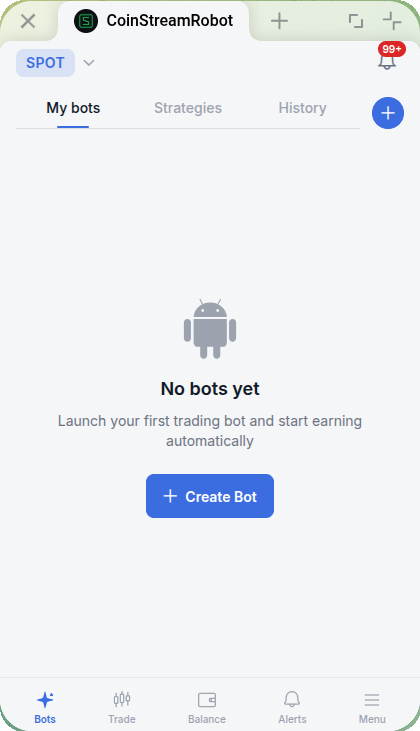
You'll land on the Bots tab showing your active bots and overall stats. To create a new bot:
- Tap the + button
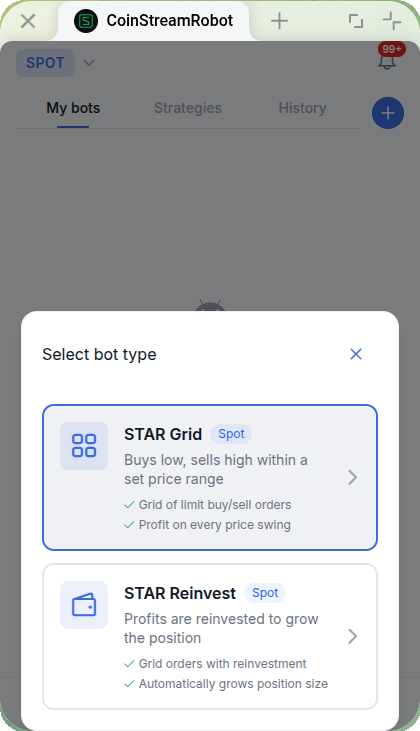
- Select STAR Grid — grid trading without leverage
- Pick a trading pair
When choosing a pair, consider:
- Liquidity — stick to popular pairs like ETH/USDT or BNB/USDT for optimal order execution
- 24h volatility — Grid bots profit from price swings, so the asset needs movement
- Familiarity — trade assets you understand
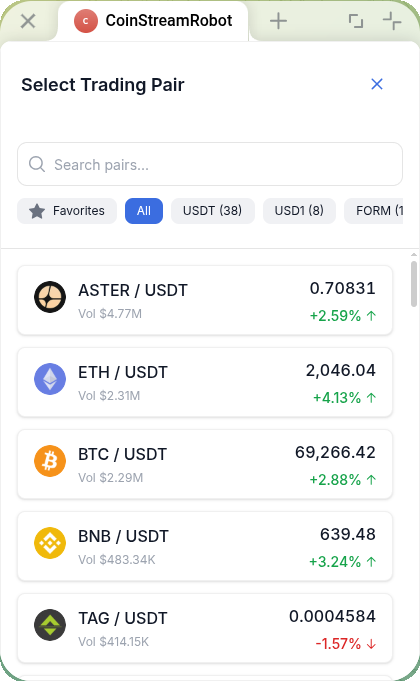
For beginners, ETH/USDT is recommended. It offers good liquidity, decent volatility, and most traders already follow its price.
Core Grid Parameters
After selecting a pair, you'll see the configuration screen. These parameters determine the bot's behavior and profitability.
Price Range
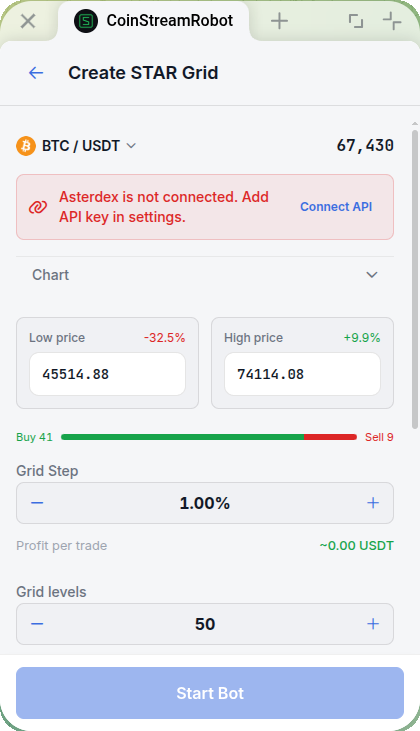
The range defines where the bot operates. Set a lower price (where the bot starts buying) and an upper price (where it sells everything).
The chart includes visual Low and High sliders. Drag them and watch the range update. Next to each input, you'll see the percentage from current price — like "32.5% below" for the lower bound.
How to pick a range:
- Check the 30-day chart
- Find the zone where price spent most of its time
- Add 10-15% buffer below for potential dips
Common mistake: setting too narrow a range. If price breaks out, the bot stops trading.
Grid Step
The step determines spacing between levels. Quick options: 0.5%, 1%, 1.5%, 2%. Or set a custom value — the minimum is 0.1%.
Steps below 0.3% trigger very frequent trades and significantly increase exchange fees. Use ultra-small steps only with a clear understanding of the fee impact.
The tradeoff:
- Smaller step → more trades, less profit per trade
- Larger step → fewer trades, more profit per trade
The screen shows Profit per trade in real-time, so you can see exactly what each buy-sell cycle earns.
Grid Levels
Levels are the number of orders in the grid. Range is 5 to 100. Quick picks: 10, 25, 50, 100.
Simple math: Investment ÷ Levels = Order size.
With 500 USDT and 10 levels — each order is roughly 50 USDT. With 50 levels — 10 USDT each.
More levels means smaller orders that trigger more often. For beginners, 10-25 levels is recommended.
Investment and Risk Management
Investment Amount
Enter the amount in USDT. Quick buttons: 25%, 50%, 75%, Max of available balance. Or use the slider.
Recommendation: start with 10-20% of your portfolio. Run the bot for a couple weeks before adding more capital.
Trailing Up
The Trailing Up toggle makes the grid follow the price upward.
Enable when: expecting an uptrend but wanting to catch pullbacks along the way.
Disable when: trading a pure sideways market with no directional bias.
Stop Loss
Stop Loss protects against deep drawdowns. If price drops to the SL level, the bot sells everything and shuts down.
Settings:
- Quick picks: -3%, -5%, -10%, -15%, -20% from lower price
- Manual price input for precise control
Trailing Stop Loss is also available — the SL moves up as price rises. If the bot profits, the new SL sits higher than the starting point.
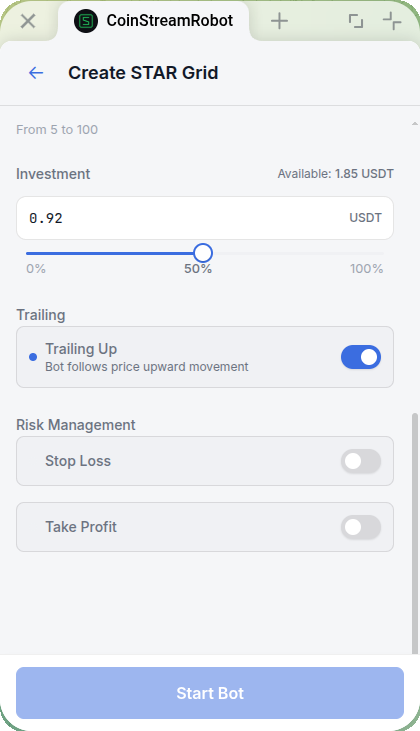
Without Stop Loss, a warning appears: "Stop Loss not set — unlimited risk." Always set SL at least -15%.
Take Profit
Take Profit locks in gains. When the bot hits the target, it sells everything and stops.
Set a target as a percentage of your investment. Quick picks: +5%, +10%, +15%, +20%.
For long-running bots, Take Profit may not be necessary. For short-term plays, it's useful for automatic exit with gains.
Recommended Strategies
Conservative Strategy
| Parameter | Value |
|---|---|
| Range | ±15-20% from current price |
| Levels | 10-15 |
| Step | 1.5-2% |
| Stop Loss | -15% |
| Trailing Up | off |
Best for: beginners, larger amounts, low-maintenance trading. Fewer trades but each one counts. Wide range reduces the chance of price escaping the grid.
Aggressive Strategy
| Parameter | Value |
|---|---|
| Range | ±5-8% from current price |
| Levels | 50-100 |
| Step | 0.5% |
| Stop Loss | -10% |
| Trailing Up | on |
Best for: experienced traders, smaller amounts, active markets. Lots of small trades, requires attention. Tight range means price can easily break out.
Sideways Market Strategy
| Parameter | Value |
|---|---|
| Range | based on 30-day support/resistance |
| Levels | 25-50 |
| Step | 1% |
| Stop Loss | just below support |
When to use: BTC or ETH in accumulation phase, price chopping around with no clear trend. Ideal STAR Grid conditions.
Volatile Altcoin Strategy
| Parameter | Value |
|---|---|
| Range | ±25-30% |
| Levels | 20-30 |
| Step | 2% |
| Stop Loss | -20% (mandatory!) |
| Take Profit | +15-20% |
Risks: altcoins can blast through any range. Always set Stop Loss and Take Profit. Don't invest more than you can afford to lose.
Configuration Example: ETH/USDT
Here's a sample configuration for an ETH/USDT STAR Grid bot:
| Parameter | Value |
|---|---|
| Pair | ETH/USDT |
| Investment | 500 USDT |
| Grid Levels | 10 |
| Price Range | 2,050 — 2,150 USDT |
| Grid Step | 0.49% |
| Order Size | ~50 USDT |
| Trailing Up | off |
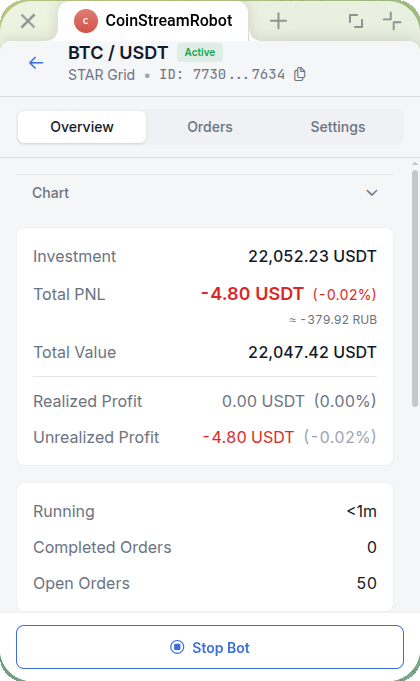
Expected Performance
With these parameters, typical results over a 12-day period:
| Metric | Value |
|---|---|
| Completed Trades | ~180 |
| Open Orders | 10 |
| Realized Profit | +4-5% |
| Average Daily Profit | ~0.04% |
| APR | ~15-17% |
Understanding the Numbers
Unrealized profit may be negative if the current price is below the average purchase price. This is normal — when price bounces back, the bot sells those positions for profit.
Realized profit is the key metric — actual money from completed trades.
Note: A $100 range (2050-2150) generates frequent trades but carries higher risk of price escaping. For lower risk, consider widening the range.
FAQ
What's the minimum to start?
Depends on the pair. For ETH/USDT, 100 USDT is comfortable. Cheaper altcoins work with 50 USDT. More capital enables more grid levels and more opportunities.
What happens if price leaves the range?
If price goes up: the bot sold all coins and waits. Funds sit in USDT.
If price goes down: the bot bought at every level and paused. You're in drawdown, but you hold the coins. Wait for recovery or cut losses.
Can I change settings on a running bot?
Partially. Trailing Up and Stop Loss / Take Profit can be adjusted. Range and grid levels are locked — stop the bot and create a new one.
STAR Grid vs STAR Reinvest — what's the difference?
Both bots use grid trading, but they handle profits differently.
STAR Grid accumulates realized profits separately — they sit in your balance and are not used by the bot. This is a "harvest and hold" approach.
STAR Reinvest automatically reinvests earned profits back into the grid, compounding your position over time. It also supports Take Profit by price (not just PNL %), which gives more precise exit control.
Choose STAR Grid if you prefer to collect profits as they come. Choose STAR Reinvest if you want compound growth and are comfortable leaving profits at work.
What are the fees?
You pay the exchange's trading fee on each trade. Coinstream does not charge any additional fees.
STAR Grid bots earn on volatility 24/7 while running autonomously. The key rule: start small and always set a Stop Loss.
Ready to start? Launch your first bot in 5 minutes.